100 Year Starship Study Symposium in Orlando, Florida October 30th to September 2nd. The goal of the 100 Year Starship Study is to create an organization with a small amount of seed money (one-time half a million dollars US) that can lead the development of an interstellar starship within the next century.
At the symposium, I joined Tan Huei Ming and Eddie Cho, both at the National University of Singapore. They had independently submitted a document to the 100 Year Starship Study and I had met them in person while participating in DARPA “The Future of Make” executive panel in Singapore.
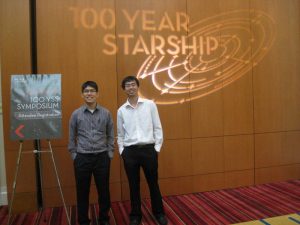
- Tan Huei Ming, Eddie Cho
Initiated by Mr David L. Neyland (
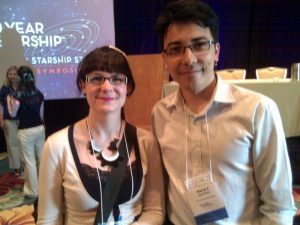
DARPA tactical technology office) and Dr Peter Worden (Director, NASA Ames Research Center). As a major driver of the whole endeavor, Mr Neyland kicked off the symposium and introduced the keynote speaker: Ariel Waldman of
spacehack.org with her talk “Hacking Space Exploration”.
[caption id="" align="aligncenter" width="300" caption="Ariel Waldman and me"]
[/caption]
Ariel is a graphic designer that has always been fascinated by space and she talked about how doing something changes how we see something and that we don’t need to be an astronaut to do space stuff… don’t even need to be at NASA to explore stuff! “. We should not let lack of knowledge prevent people to send stuff into space: we need to make technology disruptively accessible. This can be done through competitions and communities such as Google Lunar X Prize, Lockeed Martin’s Aerospace Exploration, university rover challenge, Galaxy Zoo.
There was many talks on many tracks throughout the 3 days of the symposium, all very informative and interesting.
[caption id="attachment_1675" align="aligncenter" width="470" caption="A sample of the talks"]

[/caption]
I tried focusing on those that could help guide our developments in the short-term (next decade):
- “Long-term computing” (Andreus Tziolas, Icarus Interstellar): Autonomous software and decision making processes for Icarus (presenting on behalf Dimos Homatas). Piece of software for a piece of unseen hardware that you’ve never seen before: centennial mission – twice as long as the history of computing itself. How much space is needed for a century mission? How much data will you collect? What about failures during that timespan (rebooting computers once a week)?
- “Big questions in Science-Fiction” (M. O’Keefe): who are we, how did we get here, what are we here for, what’s man’s place in the universe? The vision provided by science-fiction is one where technicians and scientists find answers to these questions. Direct inspirations from science-fiction designs.
- The Interstellar Vision: Principles and Practices (P. Gilster, Tau Zero Foundation): Near-by space missions will lead to an interstellar space mission because we will find those things that threaten Earth. Add the ability to find and nudge out the things that threaten.
- Creating Materials for the Starship (David Weiss, Eck Industries): Sophisticated alloys are the key to the metals we produce today. Transmutation is not as weird as it sound… We do it everyday (heat treatment) changes structure. Bombarding by radiation. High magnetic field processing. How to best spur materials development: challenge Grants, InnoCentive Challenge, X-Prize approach.
- Using video games to help the 100YSS” (Luke Blaize). Check out the Kerbal Space Program game.
- Marketing the Starship (Gordon Gould): Why a starship? Especially given the actual problems… Because we need a long-term goal. Thinks this is mostly a marketing problem: how to get humans excited about it.
- Project Icarus / Project Daedalus: fundamental science achievable in the near future. Making smaller versions of Daedulus (Pathfinder; 1/100th the mass of Daedalus Stage 2). Target speed: 100 au/YR, Isp: 50,000s, Vex: 500km/s).
- Building blocks to building a starship: repurpose “space trash” into new ships – DARPA’s Phoenix project.
- Jefferson Middle school presentation about their own one-month research in 100 YSS: Impressive presentation for a middle school: “Parliamentary democracy is the ideal system”. “People on long flight may go insane”. “Need to convince all religions to support this project”. “If space colonization is possible, communication is quite important”.
- Moon mining robot for the Lunabotics 2011 competition; an X Prize competition turned into a yearly student competition. See the ERAU Daytona Beach Lunabotics Competition 2011 video.
- Virgin Galactic talk (George Whitesides, President & CEO) with Sir Richard Branson doing a pre-recorded video encouraging participatings to the 100 Year Starship.
- ISS life support system (Monsi Roman, NASA): complete analysis of needs and effluents from astronauts.
- Small Body Exploration Technologies as Precursors for Interstellar Robotics (Robert J. Noble, Mark V. Sykes) : Learning how to explore small bodies here as a first step to interstellar flight. Challenges: AI, robotic governance, adapting to the unexpected. Noted the exotic idea of building an “Astrochicken”, a bio-cyber-electro-mechanical probe that can explore space independently.
- Going to Mars as a one way mission (Dirk Schulze-Makuch): Going to Mars as a one way mission (Dirk Schulze-Makuch), as a lifeboat, as a first human colony. Why one way mission? Cost of going one way: 20 billion$USD. Cost of round-trip: 100 billion$. This is due to lift-off fuel when coming back from Mars. He’s Looking for a 9-month study to produce a whitepaper on how to proceed technically and economically – need 80K$ from donors .
I was invited at the symposium to be part of the organization panel on the last day. This was my statement on that panel:
Hackerspaces are community-operated physical spaces all around the world, where people can meet and have fun making things together. Each Hackerspace is an autonomous entity, but they all share the same philosophy of having fun building things.
An Hackerspace is an environment where people can learn and tinker with technology, work in ams, participate in international competitions or do ambitious projects from flying machines to biology hacking.
XinCheJian, an Hackerspace we co-founded in Shanghai (China), is one of the many hundreds Hackerspaces all around the world that have been created in the last few years. As an example of this global collaboration we joined hackerspaces from San Francisco, New York, Australia, Maui to give a response to DARPA Request For Information as part of the 100YSS.
Hackerspaces are part of a large family of organizations called FabLab, TechShops, Makerspaces, etc that exist all around the world. Another example, is that of Tan Huei Ming is part of Ground-Up Initiative in Singapore which does urban farming and have their own workshop.
As local communities, they are adaptive to their environment and the make up of their local societies. Some are privately incorporated, some are non-profits, some are part of universities and schools, some are funded by individuals, some are sponsored by corporations or governments, some are coops.
Anyone can be part of an Hackerspace, from young kids to retirees, engineers to hobbyists, students to professionals. They all share a philosophy of making things so they are equipped to do a wide variety of inter-disciplinary projects in mechanical, electrical, software engineering disciplines, arts and/or design with a focus on teaching each other how things work and how to make things.
Hackerspaces typically use OpenSource and OpenHardware technologies and generally have a consensus-based, democratic or even anarchism approach with a focus on action. Some of them, such as Noisebridge in San Francisco with its SpaceBridge program and Melbourne Connected Community with its Lunar Numbat program, already have undertaken a variety of projects related to space.
Our proposal is to inspire some of these already existing communities to join and participate to a well-defined, realistic, global 100 years space program roadmap that can be broken down into small buildable projects with a focus on dual-use technologies on Earth and in space to work towards our long-term goal of reaching the stars.
Hackerspaces philosophy is one of openness, sharing, collaboration and communities which is essential for humanity to building the knowledge and knowhow to reach the stars. Hackerspaces are best suited to attract the kind of people fascinated by space and the promises of space. Hackerspaces, because they are born from their local communities, have organizations well-adapted to their social environments and through their members, connected to the organizations surrounding them.
They are also by their existence already self-sustainable communities.
For the purpose of the space program, instead of centrally organizing, we believe in inspiring and evangelizing through a common dream and repository of common technologies. The 100 Year Starship Study could funnel the small amount of money it has remaining into funding a variety of realistic short-term projects that fit into the larger plan with the hope that these projects can be further funded through crowd-funding and productization. This will give the opportunity to space fans, amateurs and hobbyists to move beyond part-time endeavors while equipping further Hackerspaces with the tools they need to build space technologies.
Hackerspaces can extend their existing community to work in partnership with individuals, other non-profits, universities, private companies, state-owned enterprises, governmental organizations and governments to connect efforts to a global one. By using this open platform for the 100 Years Starship, we can increase the number of stakeholders dramatically and ensure that the next four human generations are intimately involved with the global starship space program through making.
On a personal note: In the short-term, walking back from the long-term proposals discussed at this symposium and while we wait for basic breakthrough in physics to make the trip to the stars practical, I personally believe that we can focus the next few years on self-sustainable ventures around near space. This means a focus on making robots that can prospect and mine near-earth objects, use the material generated to build space factories and power stations that together can build more things. This is to both escape the gravity well tax and find a profitable way to exploit space by bringing back valuable resources to Earth. This is a necessary first step to any sustainable long-term development.
We have until November 11th to write up an RFP for the Request For Proposal. Being part of the symposium was quite an inspiring experience; such long-term thinking is probably unprecedented in the history of humanity and the challenges that we are given can advance our civilization tremendously. Given that the keynote speaker is herself a well-known hacker, there seems to be a favorable opportunity for us to take the lead here.]]>
[…] I had a round trip ticket to the US east coast for the 100 Year Starship Study Symposium, me and Min Lin also wanted to visit friends and family in Montreal (Quebec, Canada) on the same […]